Indian Territory north of the Red River
News of the WorldIndian Territory north of the Red River is the territory beyond the river boundary that gives Jefferson Kyle Kidd’s journey its most consequential divide. For Johanna Leonberger, who has lived among the Kiowa since her capture as a child, crossing south is not simply a return to Texas: it separates her from the people and homeland she understands as family. The territory is at once a place of refuge, a contested jurisdiction, and the far side of a river that neither official orders nor a rescue mission can make emotionally easy to cross.
Territory and Boundary
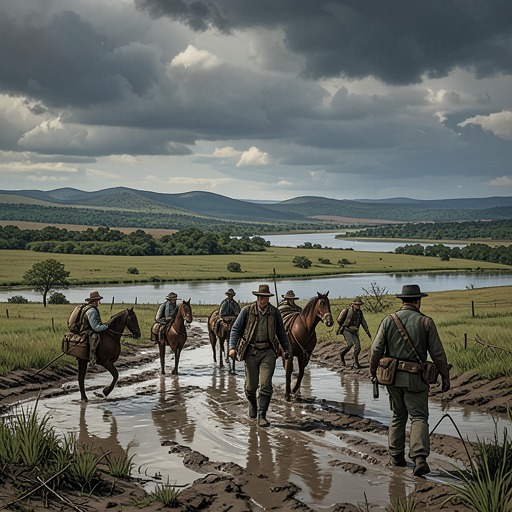
Indian Territory north of the Red River is established in the journey through the river itself. Spanish Fort lies a mile inside a great bend, while the Red River marks the boundary between Indian Territory and the land to its south. The route follows the river’s southern edge, through short, steep hills and rain-darkened country. The boundary is therefore not an abstract line on a map: it is a visible, difficult passage between the world Johanna has known and the one to which others insist she belongs.
The territory is also connected to places farther north. Britt Johnson reports that Johanna was taken from near Castroville four years earlier, when she was six, and that she has been transported from Fort Sill. The Indian Agent’s information identifies her as about ten and records that her parents and little sister were killed in the raid. Her surviving relatives, Wilhelm Leonberger and Anna Leonberger, have sent a fifty-dollar gold piece to secure her return. The journey south is thus organized by an official identification and a payment, even though neither establishes what Johanna herself wants.
A Route Governed by Unequal Authorities
The effort to bring Johanna out of Indian Territory exposes competing claims to authority. Britt says the Indian Agent has the particulars and has arranged for someone to transport the child home; Britt has undertaken to get her out of the territory and across the river. Jefferson Kyle Kidd suggests that the United States Army could deliver her, since it takes charge of captives. Britt answers that it no longer does so. The return depends instead on an individual freighter’s willingness and ability to carry out the assignment.
Kidd’s decision is shaped by his familiarity with the destination. He has spent years in San Antonio, married into an old San Antonio family, and knows the people and the route. The narrative places this practical knowledge amid unsettled ideas about free Black people after the war: in North and West Texas, Black freighters and scouts are present, and the Tenth U.S. Cavalry is all Black, while the wider population has not resolved its views. The journey across the boundary unfolds in a society described as being in flux, where formal institutions and local relationships do not neatly settle who can travel, protect, or decide.
An Army patrol appears on the road while Kidd and Johanna are traveling south. About ten mounted infantrymen approach, and Kidd tries to reassure her by making signs for good and friend before lifting her into the wagon bed. The encounter makes the Army’s presence tangible, but it does not dissolve the conflict over her return. Instead, the patrol is one more authority Johanna must face while moving away from the territory she recognizes as home.
The River as Separation and Failed Return
For Johanna, the country on the far side of the Red River holds the possibility of her mother, father, siblings, and kin group. As she walks beside the wagon, she refuses both the shoes and the offer to ride. She sings rather than weeps, carries her shoes around her neck, and regards the unfamiliar clothing imposed on her as a confinement. She believes she is being taken among aliens and considers escape or starvation preferable to life separated from her people. The narrator makes the asymmetry plain: those arranging her return call the destination home, but she experiences the journey as exile.
That divide becomes literal during the rising flood. Johanna reaches the water’s edge and sees a group of Kiowa on the opposite bank, forced from their camp by the flood. She calls to them in Kiowa, asking to be rescued and taken back. They are too distant to hear her over the river. When one warrior fires a warning shot that strikes the red stone near her, the shot establishes a second barrier: the people across the water do not recognize who she is. Jefferson Kyle Kidd and the fiddler fall flat in the grass, while Johanna’s hoped-for reunion remains out of reach.
The river therefore separates more than jurisdictions. It divides a child’s remembered and chosen belonging from the family and society to which officials are returning her. The attempted crossing does not restore her place among the Kiowa; the distance, flood, and warning shot leave her suspended between communities. The territory’s boundary has been crossed in one direction, but its personal meaning cannot be settled by crossing back.
Beyond the Boundary
The story also connects Indian Territory to routes of danger beyond the river. Comanche raiders come south from the Red River across the open country around Lampasas, then favor the concealment, water, and isolated farms of the hill country. Their movement makes the boundary porous in another way: people, danger, and competing claims to land travel across it, while towns and forts offer no complete guarantee of protection. Kidd watches the road and surrounding country for signs of raiders, prepared to abandon the wagon and flee with Johanna if necessary.
The later account of Johanna’s life preserves the Kiowa as more than a setting she has left behind. The warriors’ lives endure in stories of bravery and daring, alongside the death of Britt Johnson and his men and the memory of Cicada, the little blue-eyed girl taken from them by the Indian Agent. That final remembrance complicates the language of return: the journey can carry Johanna toward surviving relatives, but it cannot erase the life, relationships, and people on the other side of the boundary.